
cafe supplies
now browsing by tag
How To Choose Packaged Biscuits for Coffee Service
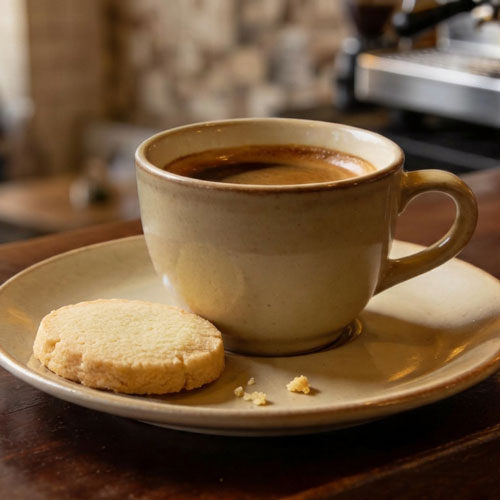
The biscuit sitting beside an espresso is a seemingly small thing. But it is also, for the customer receiving it, a small signal about the café. A shortbread that crumbles cleanly, with a pronounced butter flavour, tells a customer something about the coffee they’re about to drink. A dry, forgettable bickie in generic packaging tells them something too.
Most cafés carry biscuits. Far fewer choose them with the same attention they give to coffee beans or milk.
This guide covers how to choose packaged biscuits, how to match your range to the occasions your café actually runs, and what storage looks like in a working kitchen.
What makes a good biscuit for coffee service?
Three things determine whether a biscuit works on a saucer: texture, flavour, and consistency.
Texture: does it hold on the saucer?
Texture is the first filter. What you want is a biscuit with enough structural integrity to sit cleanly on a plate, firm enough to hold, but with a bite that gives without shattering. Oat-based biscuits like an Anzac tend to have a dense, chewy crumb that holds together well in the hand. A well-made shortbread has enough butter content to keep its shape on the plate but yields cleanly when eaten. Both survive a single dunk without disintegrating.
Bush Cookies Anzac Biscuits: made with rolled oats, golden syrup and desiccated coconut, with a dense, chewy crumb that holds its structure on a saucer and takes a dunk without falling apart.
Butter Shortbread Cookies: high butter content, clean snap, keeps its shape on the plate but yields without resistance when eaten.
Flavour: does it complement the coffee?
Flavour compatibility with the coffee is the second filter. The biscuit is not competing for attention; it is sitting alongside a drink with its own acidity, bitterness, and body. A biscuit with an intensely sweet filling or a sharp citrus note can pull against a long black or an espresso rather than complement it. A buttery shortbread or a golden syrup Anzac sits alongside coffee without creating contrast the customer notices as a problem.
Consistency: does every serve look the same?
Consistency is the third, and the easiest to overlook. Every biscuit on every saucer should be the same size, the same weight, the same shape. Not because uniformity is a virtue in itself, but because variation reads as carelessness at the table. A biscuit that is slightly smaller than the one served yesterday, or visibly misshapen against the last, creates an impression the coffee cannot fix. Slight natural variation in a hand-formed biscuit is a different matter, that reads as made rather than manufactured, but gross inconsistency in size or weight is a problem in any service context.
Does the coffee style change which biscuit you should serve?
Yes, and the difference is worth understanding before you fix your range.
Milky drinks: flat whites, lattes and cappuccinos
Milky drinks such as flat whites, lattes, and cappuccinos, have a sweetness and body that can carry a wider range of biscuit flavours. A butter shortbread sits comfortably alongside a flat white because the milk softens the coffee’s acidity and the flavours don’t compete. The fat in the biscuit and the fat in the milk tend to reinforce each other.
Black coffee: espresso and long black
Black coffee is less forgiving. An espresso or long black is acidic, sometimes bitter, and has no dairy buffer. Intensely sweet biscuits, heavy on icing, fruit jam centres, or passionfruit cream, can create a flavour clash that neither the biscuit nor the coffee recovers from. What works better here is a biscuit with depth rather than sweetness. The warmth of the Ginger and Date extends the coffee rather than fighting it.
Ginger and Date Biscuits: a spiced, fruit-dense biscuit with a warmth that sits particularly well alongside a long black or espresso.
This does not mean you need a separate biscuit for every drink style on the menu. It does mean that if your café skews heavily toward black coffee drinkers, a specialty espresso bar or a filter coffee programme, for instance, a strongly sweet or cream-filled biscuit is a worse fit than a plainer, less sweet option. The flavour logic of the biscuit should follow the flavour logic of the coffee programme.
How do you build a biscuit range for café service?
The right number of varieties is determined by how many distinct service occasions your café runs, not by a formula.
Everyday coffee service
A café running a single coffee service, no high tea, no catering, no set menu, can often cover its full range with two or three biscuits. One plain option that works with every drink style, one with a little more character for customers who want something more substantial, and a gluten-free option that genuinely belongs on a saucer rather than being an afterthought. That last point matters: the gluten-free biscuit should be chosen on the same criteria as the rest of the range (texture, flavour, consistency) and not simply because it carries the label.
High tea and occasion service
A café running high tea alongside daily coffee service needs a wider range. High tea biscuits operate under different expectations: they are part of a plated spread, not a standalone accompaniment. They need to hold their appearance on a tiered stand for longer than a single sit-down service, look considered next to a scone and a finger sandwich, and suit a table that may include several different preferences. A Vanilla Melting Moment earns its place on a high tea board in a way it would not on an everyday coffee saucer. The occasion justifies the additional line.
Vanilla Melting Moments: soft, butter-rich crumb with a vanilla cream centre; holds its appearance on a tiered stand and reads as considered next to a scone or finger sandwich.
Passionfruit Cream Biscuits: bright flavour and sandwich construction that earns its place on a high tea board.
The practical limit is storage and throughput. Every additional variety is an open pack in the kitchen. If your volume is not moving through a full pack of each variety before the open pack loses its crispness, then a broader range is working against you, not for you. The right range is the one where every variety is being pulled through at a rate that keeps it fresh, and every variety is doing a job that another biscuit on the range cannot do as well.
Where gluten-free fits in the decision
The gluten-free decision belongs here, not in a separate category. You are not adding a dietary accommodation product. You are adding a biscuit that happens to be gluten-free, and it should be chosen on flavour and texture first.
Gluten Free Chocolate Chip Cookies: holds on the saucer and serves alongside the rest of the range without separate handling or plating.
Passionfruit Cream Gluten Free Cookies: sits as naturally on a high tea board as its wheat-based equivalent.
How should you store biscuits in a working kitchen?
Dry storage versus the cool room
Dry storage only. Biscuits do not belong in the cool room, and the one exception (cream-filled varieties in extreme summer heat) creates more problems than it solves, because refrigeration introduces moisture that destroys the texture of any biscuit within hours. A cool room that is opened repeatedly throughout service is not a controlled environment for biscuit storage.
Managing open packs
An unopened pack in dry storage will hold its texture and flavour for several months. The relevant variable is the open pack. Once a pack is opened in a working kitchen, with its ambient humidity, heat from espresso equipment, and regular opening and closing, the biscuits will begin to soften within a few days, sometimes faster in summer. The practical answer is to decant into a sealed container at the start of each week, not to leave the pack open on the bench.
Plain biscuits are more forgiving in a warm kitchen environment than cream-filled varieties. A cream biscuit softens significantly faster once exposed, because the cream centre absorbs moisture and the whole biscuit loses its snap. If your kitchen runs warm and you are moving through cream biscuits slowly, the open pack life is a practical constraint on how many you should prep at once.
The biscuit range that works for your café is the one built around the occasions you actually run, and the coffee styles you actually serve, not the one that covers every possible customer at the cost of open packs going soft in the kitchen. Get the texture and flavour logic right first, keep the gluten-free decision inside that same logic, and the rest follows. Browse the full Bush Cookies range at Opera Foods.
This article was reproduced on this site with permission from operafoods.com.au the “Café Supplies Wholesaler”.
See original article:- How To Choose Packaged Biscuits for Coffee Service